
The Three Systems Every High-Intensity Household Needs
The Mamafesto Containment Framework™
Structure that stabilizes families raising neurodivergent and high-intensity kids.
Most parenting advice focuses on behavior.
Charts.
Consequences.
Rewards.
Discipline systems.
But high-intensity households often discover something quickly:
Behavior strategies fail when the environment itself is unstable.
Children who experience the world with heightened sensitivity, stimulation, and emotional intensity cannot regulate themselves inside chaotic systems.
Which means the real problem often isn’t the child.
It’s the structure surrounding the child.
The Mamafesto Containment Framework™ was created to address this exact gap.
Instead of focusing only on behavior, it organizes the household around three stabilizing systems that support neurodivergent nervous systems.
When these systems are present, escalation decreases, emotional regulation improves, and the entire household becomes more predictable.
The Mamafesto Containment Framework™
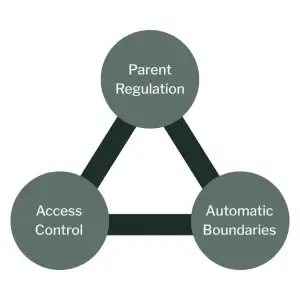
Each system plays a specific role in stabilizing the environment.
Remove one, and the entire structure becomes fragile.
Strengthen all three, and the household gains containment — the ability to hold big emotions, big energy, and big personalities without constant conflict.
System One
Access Control
High-intensity households are extremely sensitive to stimulation.
Noise.
Screens.
Transitions.
Schedules.
Sensory input.
Every additional layer of stimulation adds load to a child’s nervous system.
When that load exceeds what their brain can regulate, escalation begins.
This is why a child may appear “fine” one moment and completely overwhelmed the next.
Access Control is the system that manages how much stimulation enters the household environment.
Instead of constantly correcting behavior after a meltdown begins, Access Control reduces the triggers that overload the system in the first place.
Examples of Access Control include:
• Limiting competing sensory inputs
• Managing screen exposure
• Structuring transitions between activities
• Creating predictable rhythms in the home
• Designing calmer physical environments
Access Control is not about restriction.
It’s about protecting nervous system capacity.
When stimulation is managed, children have far more room to regulate their emotions.
System Two
Automatic Boundaries
Many parents in high-intensity households find themselves negotiating constantly.
Every request becomes a debate.
Every limit becomes an argument.
Every rule becomes a negotiation.
This constant back-and-forth drains both the parent and the child.
Automatic Boundaries solve this problem.
An Automatic Boundary is a limit that does not require repeated enforcement or emotional energy from the parent.
It exists as part of the system itself.
Instead of saying the same rule twenty times a day, the environment makes the boundary clear and predictable.
Examples of Automatic Boundaries include:
• Devices that shut down at a certain time
• Household rhythms that repeat daily
• Clear rules tied to environmental cues
• Physical structures that support limits
Automatic Boundaries reduce conflict because they remove the need for constant parental intervention.
The rule becomes part of the environment, not a battle between parent and child.
System Three
Parent Regulation
This system is the foundation of the entire framework.
Children borrow regulation from the adults around them.
When a child’s nervous system is escalating, the parent’s nervous system becomes the stabilizing anchor.
But parenting high-intensity kids is exhausting.
Constant stimulation, meltdowns, sensory overload, and emotional storms can push even the most patient parent toward burnout.
Parent Regulation focuses on maintaining the adult’s stability so the household has a consistent emotional center.
This includes:
• recognizing nervous system overload in parents
• building recovery rhythms into the day
• separating adult emotional regulation from child escalation
• reducing reactive parenting cycles
Parent Regulation is not about perfection.
It’s about maintaining enough stability that the parent can lead the system instead of being pulled into every emotional surge.
When the parent remains regulated, the household gains an emotional reference point.
How the Three Systems Work Together
These systems are designed to support each other.
Access Control reduces sensory overload.
Automatic Boundaries reduce daily conflict.
Parent Regulation stabilizes the emotional center of the home.
When all three are present, the household becomes a contained system rather than a reactive one.
This doesn’t eliminate big emotions.
High-intensity kids will always feel deeply, react strongly, and experience the world in powerful ways.
But the system surrounding them becomes strong enough to hold that intensity.
And that’s where stability begins.
The Mamafesto Method™ was built from lived experience — raising multiple neurodivergent children while navigating homeschooling, sensory needs, emotional storms, and the daily complexity of high-intensity family life.
It’s not a theory.
It’s a structure designed for families whose reality doesn’t fit traditional parenting models.
Because when the system changes, the household changes.
Structure restores stability.
Systems protect relationships.